Beating one of New Zealand’s most common cancers
25 March 2025
New Zealand has 1200 deaths a year from colorectal cancers. That is four times the road toll and about as preventable, Professor Parry Guildford said. So why is the incident in younger age groups and in Māori and Pacific people rising?
If Otago University-based researcher Professor Guilford has his way, these statistics are about to change.
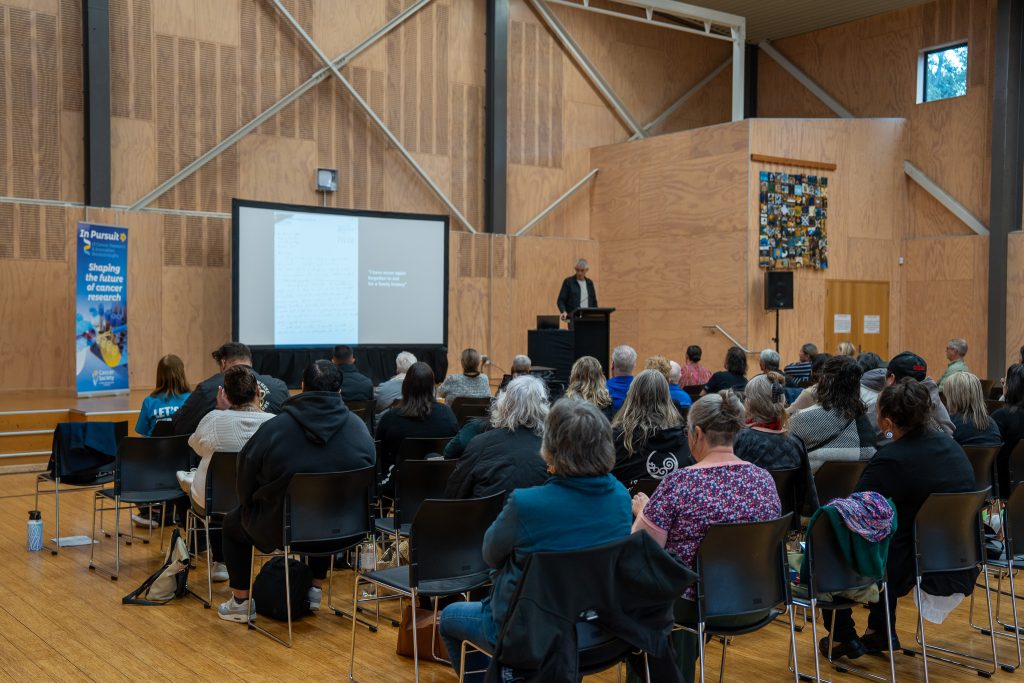
Professor Guilford was a keynote speaker at In Pursuit, the Cancer Society’s inaugural conference and his work was a major attraction.
He blames constraints, costs, and resources for the worsening statistics. He lays responsibility for the outcomes at the feet of three things:
- Centralised diagnostic services and decision-making
- Risk stratification and prioritisation, and
- Willingness to accept compromised service.
Professor Guilford said people want to be empowered to look after their families. They do not want gatekeepers who decide who gets treated and who does not, impacting their families’ futures. Nor do they want waiting lists.
“What they do want is a trusted service and accessible care, both geographically and culturally.
“To provide this we need a community-driven, early detection programme that allows communities to be involved, and accessible cancer testing technology.”
Professor Guilford said these principles were the driving force behind his research, along with a desire to prevent people developing colorectal cancer by catching it before it has a chance to take hold.
His research on accessible circulating tumour DND (ctDNA), a blood test for people with symptoms, risk factors or family history of colorectal cancer, has been well documented, but Professor Guilford wants people to understand the enormous benefits of ctDNA. The test is:
- Sensitive, and highly specific – it will not clog the system with false positive results
- Scalable, flexible, and accessible – enabling organic growth with communities, and,
- A step change on the current stool (iFOBT) – it takes thirty positive iFOBT tests and subsequent colonoscopies to diagnose one cancer.
Professor Guilford said the test will lead to reduced reliance on big hospitals, better care for rural communities and, adjunct to the National Bowel Screening Programme, reduce unnecessary colonoscopies.
So why is ctDNA such a game changer? It has the ability to pick up cancer early before it causes damage and is still easily treatable. It does this by identifying the DNA of tumour cells in the blood. Testing can be conducted widely and cheaply, anywhere from the local community center, marae, or GP office, which increases access and supports people to undergo screening.
He said ctDNA detection using the Oxfords Nanopore sequencing system has low capital cost, was portable, did not need a fancy laboratory and was highly scalable. Real-time data was also provided, which could be obtained and held locally, and would be a valuable educational resource.
“The advantages of a New Zealand grown test are enormous. It means the test is owned by the community, not an overseas corporation, not driven by profit. It would have built in equity and would be developed alongside health education with no gatekeepers.
“Delays in the system will be reduced, and we will receive instant feedback and be able to make constant improvements.”
Professor Guilford said the technology would also provide a pipeline for other cancers and hopefully provide better outcomes for even more New Zealanders.
His aim is to have the test in wide use within two years.
Donate NOW